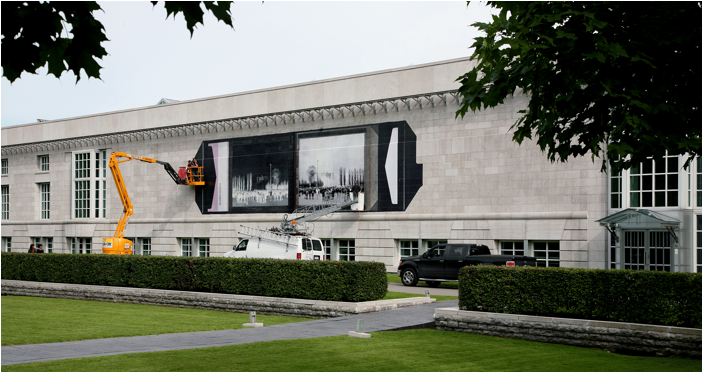
Workers complete installation on the
north façade of the Canadian Centre for Architecture, August 28th/09
Public
Installation at the Canadian Centre for Architecture
Created for Le Mois de la Photo
à Montréal 2009 – The Spaces of the Image
Photography Proof
by Robert Burley 2009
Co-curated
by Louise Desy (CCA Associate Curator of Photography) and Gaëlle Morel (Le Mois
de la Photo Guest Curator)
Production
Assistants: Sabrina Maltese & Elena Potter
This
project supported by: Ryerson University Creative Fund, Canada Council,
Canadian Centre for Architecture, Le Mois de la Photo à Montréal 2009, 3M
Canada Inc.
This digitally produced mural, measuring 66’ x 18’, reproduces a
processed Polaroid photograph showing both the negative and positive versions
of the image. The photograph itself was created in December 2007 and shows a
crowd watching the scheduled implosion of a Kodak-Pathé film factory in
Chalon-sur-Saône, France. The Polaroid film that was used to create the image
has recently joined the ranks of numerous other traditional photographic
products that are quickly becoming obsolete; Polaroid announced in February of
2008 that it would stop manufacturing instant film products due to decreased
demand. Both the Kodak factory and the Polaroid film are casualties of a recent
paradigm shift from traditional photographic film to digital imaging
technology.
This installation presents an image of a significant event in
the history of photography. The crowd that has gathered is witnessing the
end of traditional photography in the very place where it began. It was after
all, this town in central France where Joseph Nicéphore Niépce created the
first surviving photograph in 1826. Photographic Proof can be
interpreted in two ways: first a photographic evidence that the event
took place; secondly as the object itself, proof is a term used to
describe a test print.
As an artist who
has used photographic film my entire life, I've created this installation to
pay homage to the photographic process at a time when radical changes are affecting
how images are created, disseminated and consumed. As I mourn the loss of
the physical materials that have defined photography for the past century, I am
enthralled by the unprecedented control offered to me by digital media.
While I welcome the release from technological limitations in a
post-photographic age, I find that I've lost the privileged relationship to
reality that only photography could once offer. As all visual media shift
from the material object to encoded data, the photograph's ability to create,
"a trace, something stenciled off the real world" is now more tenuous
than ever. This work questions the changing roles of photography, the
museum, the artist and the viewer in a digitally mediated world.