Public Installations 2008/2009
The Canadian Centre for Architecture - Robert Burley Exhibition from Ben Philippi on Vimeo.
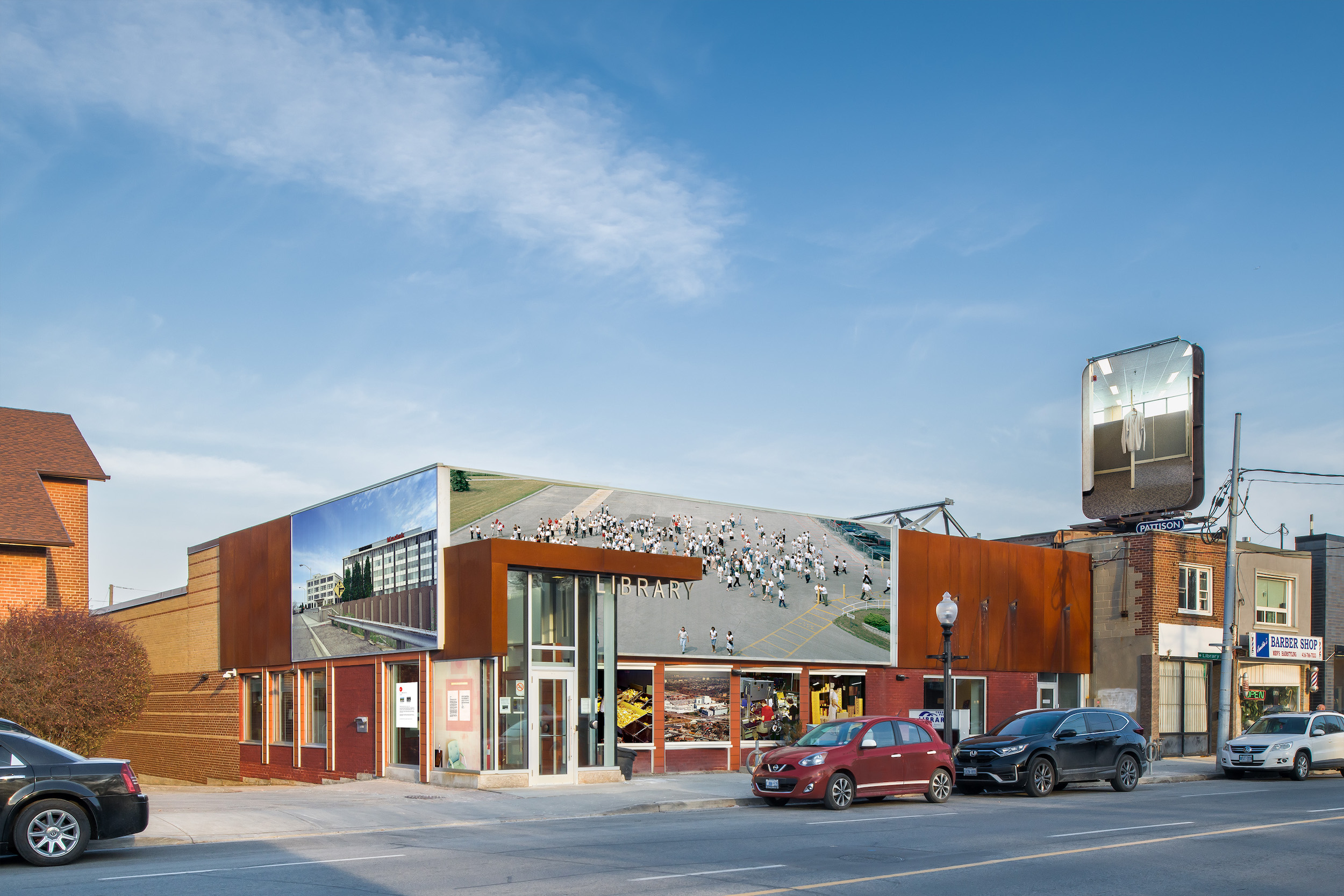
In 2008 and 2009 I was commissioned by the Contact Photography Festival in Toronto and Le Mois de la Photo à Montréal to complete large scale public installations in relation to the festival themes.
In both instances I used photographs I’d created at scheduled implosions of Kodak film plants: the first in Rochester, New York, the Eastman Kodak Company’s birthplace (1888), the second is Chalon-sur-Saône, France, the birthplace, in 1827, of photography itself. These installations are meant to address the changing nature of the photographic image as well as my own transition from industrial to information age. These images are ephemeral and dematerialized yet their scale and context command attention, encouraging the viewer to question the changing nature of the photography in today’s society . The subject of the photographs is the demise of places which manufactured light-sensitive films and papers, the materials that have defined photography for the past century. RB
Disappearance of Darkness 2010
Unthinkable - Matt Galloway, CBC Radio Interview
Former trailblazer Kodak files for Chapter 11 - Associated Press, The Wall Street Journal
The Disappearance of Darkness from Robert Burley on Vimeo.
The photographic materials and systems I’ve used throughout my career are disappearing at an alarming rate. Over the last five years, companies such as Kodak, Agfa, and Polaroid have been pushed into an economic free-fall as the demand for their long-established products has evaporated. The end of the analogue era is evident in the recent closings and demolition of large-scale manufacturing facilities dedicated to the production of conventional photographic products.
During the past five years I have photographed numerous facilities in Canada, the United States, and Europe where blocks of silver were dissolved in nitric acid, mixed with the tissue of animals, and coated onto film and paper so the world could make pictures. The goal of my work is to explore the places where the alchemy of the photographic process was practised on a massive scale over the last century. The essential feature of these factories was, ironically, darkness: manufacturing took place in the absence of light—a characteristic that has defined the photographic process since it was first invented in 1839. The act of photographing is often associated with a desire to record something on the verge of change or disappearance. In this case, my subject is the medium itself.
Great Lakes 2006
The shorelines of the Great Lakes vary from landscapes of remote natural wilderness to the man made edges of some of the world’s largest cities. I grew up on a rural land mass that juts out into Lake Ontario, have lived in the cities of Toronto and Chicago and vacationed on the shores of Lakes Huron and Superior. Throughout this time, the calming view of the lake’s horizon has been a constant in my life.These photographs explore the vistas of the Great Lakes using a large format camera and long exposures in the light of early dawn. Whether it is from the rock face of the Canadian Shield on the north shore of Superior or a recently created landfill on the shores of Lake Ontario, my images examine the places where land, water and sky meet. In all instances the resulting photographs are natural sites dominated by the deep open space created by sky and water. This view of nothingness becomes as much about a state of mind as it is a manifestation of geography. RB
Instruments of Faith 2003
This project explores six downtown Toronto synagogues that were established in the early part of the 20th century and remain active today. I was drawn to this project by the beauty of the buildings and their connection to the City’s history. It was also of great interest to me that of some 30 active synagogues that were established in downtown Toronto by 1930, only six remain vital today. These buildings are distinctly urban in character; their exteriors, which share limited space with the adjacent businesses and residences, embrace the street. Like the buildings themselves, the sanctuaries are confined by the limited footprint of the structure, which accentuates height over elbow room encouraging the congregations to crowd together for services. These intimate one room designs are steeped in the history of the communities which created them. Memories of founders and congregants are incorporated into furniture, light fixtures, wall tablets and built ins. The resulting spaces, created as ‘instruments of faith’ to encourage spiritual life and community bonds, have a uniquely timeless quality. For additional information see: Exhbition Website
House-Home 1999
Strachan House is a unique form of housing that has attracted international attention since it opened in December 1996. It was created to accommodate and respond to, the specific needs of chronically homeless men and women. In a turn of the century abandoned timber and brick warehouse, Levitt Goodman Architects designed a series of interior houses connected by streets to lodge 70 residents. The photographic component of this project was collaborative, with Debra Friedman, and presents a visual record of the Strachan House from the initial phases of construction to its inhabited state. Over a period of two and a half years Friedman concentrated on making portraits while I documented the architectural components of the project. The combined images by myself and Friedman not only document the structural evolution of Strachan House but also explore the ways in which the residents have created homes for themselves. These diptychs are meant to blend the environmental portrait with a record of the environment, a technique commonly employed by editorial publications that cover home decor. RB
Viewing Olmsted 1996
Viewing Olmsted was commissioned by the Canadian Centre for Architecture in Montreal under the direction of Phyllis Lambert, Founding Director and David Harris, Associate Curator of Photographs. Seventy four sites designed by Frederick Law Olmsted, North America’s most important landscape architect were selected by Olmsted scholar Cynthia Zaitzevsky, who provided documentation for myself and two other photographers participating in the commission, Lee Friedlander and Geoffrey James. Over a five year period, myself and the two other photographers had the opportunity to photograph these parks, estates, etc. Viewing Olmsted was mounted as an exhibition at the CCA in 1997 and traveled to four other venues over a two year period. An archive of approximately 1000 photographs was created by the CCA over the five year period 1989 to 1994 that the commission was executed. For additional information see:Canadian Centre for Architecture
Glenn Gould 1990
The Places of Glenn Gould was commissioned by DU Die Zeitschrift der Kultur, a Swiss publication that dedicated an entire issue to Gould, eight years after his untimely death. These photographs explore the places that were inhabited and frequented by Gould over his lifetime. The images presented here offer a glimpse into the life of a man who has been described as a genius, an outsider and an eccentric. Gould, who died just a few days after his 50th birthday in 1982, left behind a rich legacy as a musician, writer and media producer. The YEAR OF GLENN GOULD begins on September 25th, 2007 marking the anniversaries of Gould’s birth, first concert in Moscow and premature death. For additional information see: Glenn Gould Foundation
Viewpoints 1989
Viewpoints:100 Years of Architecture in Ontario presents a series of building projects that were selected to provide an overview of a century of architectural history in the province. The final exhibition and publication was created to celebrate the 100th anniversary of the Ontario Association of Architects. I along with two other photographers, Steven Evans and Andre Beneteau, photographed a total of 35 projects that were selected by curator/architect Ruth Cawker. This exhibition was not meant to be a historical survey but rather a presentation of significant projects built during the first 100 years of the OAA’s existence. The project was organized into the five thematic sections that included: Mainstreet, Public Visions, Space of Industry, Domestic Realm and Ritual Space covering both historical and contemporary building projects. The exhibition opened at the Agnes Etherington Centre in Kingston, Ontario in May of 1989 and was circulated to other venues in Toronto, London, Windsor, Kitchener, Burlington and Thunder Bay until 1991.
ORD 1986
Alvin Boyarsky has described O’Hare Airport as Chicago’s Versailles. Between 1984 and 1987 I focused on this project as an investigation of an unexplored urban landscape, in this case a mid western prairie adapted to accommodate air travel. My objective was to explore this large tract of land that was usually experienced either from the air, or from a runway travelling at high speeds. I was interested in the abrupt transition between the densely populated terminals and the edges of the airfield that included picturesque wooded areas inhabited only by wildlife. Two years into the project I began to work with Larry Viskochil, Curator of Photography at the Chicago Historical Society on an exhibition. In 1989, O’Hare Airport: Airfield on the Prairie, opened at the CHS with an accompanying catalogue. The exhibition of 103 chromogenic prints, along with additional images not included in the show, were acquired by the CHS for the Prints and Photographs Collection. The work was also exhibited in Toronto at Gallery TPW and acquired by a number of museum collections including the Canadian Centre for Architecture in Montreal.
Don Valley 1981
The Don Valley is part Toronto’s ravine system, a complex network of natural gullies and rifts that interrupt an otherwise flat urban landscape organized into a grid of city streets. Adapted as a transportation utility corridor, the Don Valley includes a major expressway, a railway line, industrial compounds and numerous utility towers and pipelines. As a landscape this site maintains many of its natural qualities while serving a utilitarian role in the city. Created over a two year period this project was part of the Toronto Documentary Photography Project, an exhibition celebrating the city’s sesquicentennial shown at the Harbourfront Art Gallery in 1984.
Stages 1980
This work originated, more or less, as the result of working at a school of architecture. While photographing architectural models I became intrigued by the way things are made to appear believable through the collaboration of construction and rendering i.e. the model and its photographic image. As is the case with all illusions, the success depends upon the perspective of the viewer. The photographs I’ve created are meant to amplify and reveal the illusion simultaneously. The resulting paradox is intended to encourage the viewer to consider the extent to which the world is configured to create illusion and photography’s complicity in the ongoing configuration of the world as image. RB
About
Robert Burley is an established artist who has been photographing for over twenty years. His work explores the relationship between nature and cities, architecture and the urban landscape. His photographs have been extensively published, exhibited and collected on an international level. Robert currently teaches at Ryerson University’s School of Image Arts in Toronto, Canada. …
read more